Local detail
What Is Going On
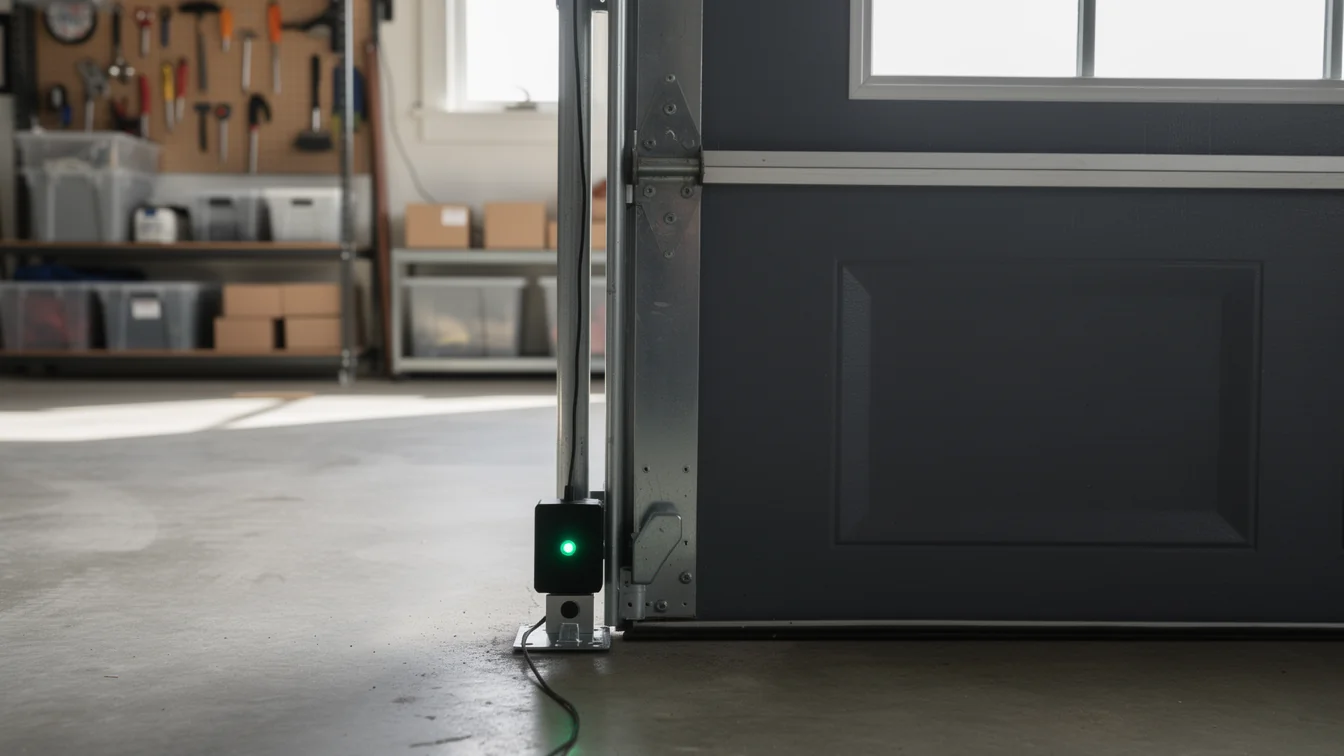
The two small eyes near the bottom of your track - the photo sensors that stop the door from closing on something - work by shooting an infrared beam across the opening. When the lenses line up, the light hits dead center and the door closes normal. When they don't, the opener either refuses to close the door at all or blinks at you and reverses halfway down.
Most of New Berlin's housing went up between 1938 and 2000, with the median around 1978 and the heaviest concentration in the 1960s and '70s builds. That matters here because a lot of these garages still have the original wood jamb or a slab that's shifted a half-inch or more since the brackets went in. The sensor brackets are small, often held with a single screw into wood that's dried and moved over fifty-plus years. A door that worked fine last fall can be off by enough to trip the safety circuit by spring.
This isn't usually a broken sensor. It's almost always a bracket that's nudged, a wire that's been pinched, or a lens that's dirty or fogged. Jumping straight to a new sensor kit before checking alignment wastes money.
The area
Leaving It Alone
A door that won't close, or one that closes and immediately reverses, is the opener telling you the safety circuit is broken - not a suggestion, a stop. Some owners disconnect the sensors or hold the wall button down to force the door shut. That defeats the one thing that keeps the door from closing on a kid, a pet, or a bike left in the opening.
If you leave a misaligned sensor alone, the practical risk isn't just safety - it's that most openers default to a slow, grinding close-and-reverse cycle that puts extra wear on the motor gear and the drive mechanism every single time it tries and fails. Across the 100,635 owner-occupied houses in this service area, a good share of them are running openers from that same 1960s-70s wave of construction, so the gears inside are already older than the sensors themselves. Forcing the cycle repeatedly shortens what's left of that motor's life.
A five-minute check - wipe the lenses, confirm both LED indicators are solid, nudge the bracket back square - solves most of these. Leaving it for months usually turns a bracket fix into a motor replacement.
What we find
What the Weather Here Does to It
New Berlin sits in a cold-severe climate band, and that's the other half of why these sensors drift. Freeze-thaw cycles move concrete slabs and the wood jambs bolted to them. A bracket that's dead level in August can be a quarter-inch off by February once the ground under the slab heaves and settles through a few hard freezes.
Condensation is the other piece. When a heated garage sits next to a cold, uninsulated one, or when a warm front moves through after a stretch of sub-zero days, the lenses fog just like a car windshield. A sensor that's perfectly aligned can still throw a fault code because the beam can't get through the moisture on the glass.
Salt spray tracked in on tires doesn't help either - it builds a film on the lens faster than dust alone would. In a milder climate this wouldn't show up as a seasonal pattern; here, it does. If your door starts acting up every year around the same cold snap, that's the slab and the glass, not a coincidence.
How we work
What It Costs
We don't have a flat number to put here, and giving you one without seeing the door would be a guess dressed up as a quote. What we can tell you is what drives the cost: whether it's a bracket re-alignment versus a full sensor replacement, whether the wiring under the bracket is original to a 1960s-70s install and brittle, and whether the opener itself is old enough that the sensor connector is an obsolete style that needs an adapter.
Median household income across this service area runs around $109,038, and most of the jobs we see here are straightforward alignment or lens-cleaning calls rather than full sensor swaps - the hardware usually outlasts its alignment. A full sensor kit replacement costs more than a bracket adjustment, but it's not a common need unless the wiring itself has corroded or a bracket has snapped.
The honest limitation: if your opener is old enough that the manufacturer no longer makes a matching sensor pair, you're looking at either a universal retrofit kit or a full opener replacement, and we'll tell you straight which one makes more sense before you spend money on the smaller fix.
Talk to a local pro
Garage door trouble in New Berlin?
Same-day service with honest, upfront quotes.