Local detail
What Is Going On
Most of the opener trouble we see in New Berlin starts with age, not a single dramatic failure. Housing here runs from 1938 to 2000, with the median build year landing around 1978, and that puts a lot of garages on their second or third opener since the house went up. Chain-drive units from that era were built to run the door, full stop - no battery backup, no Wi-Fi status light, nothing to tell you the circuit board is starting to go until it just stops responding.
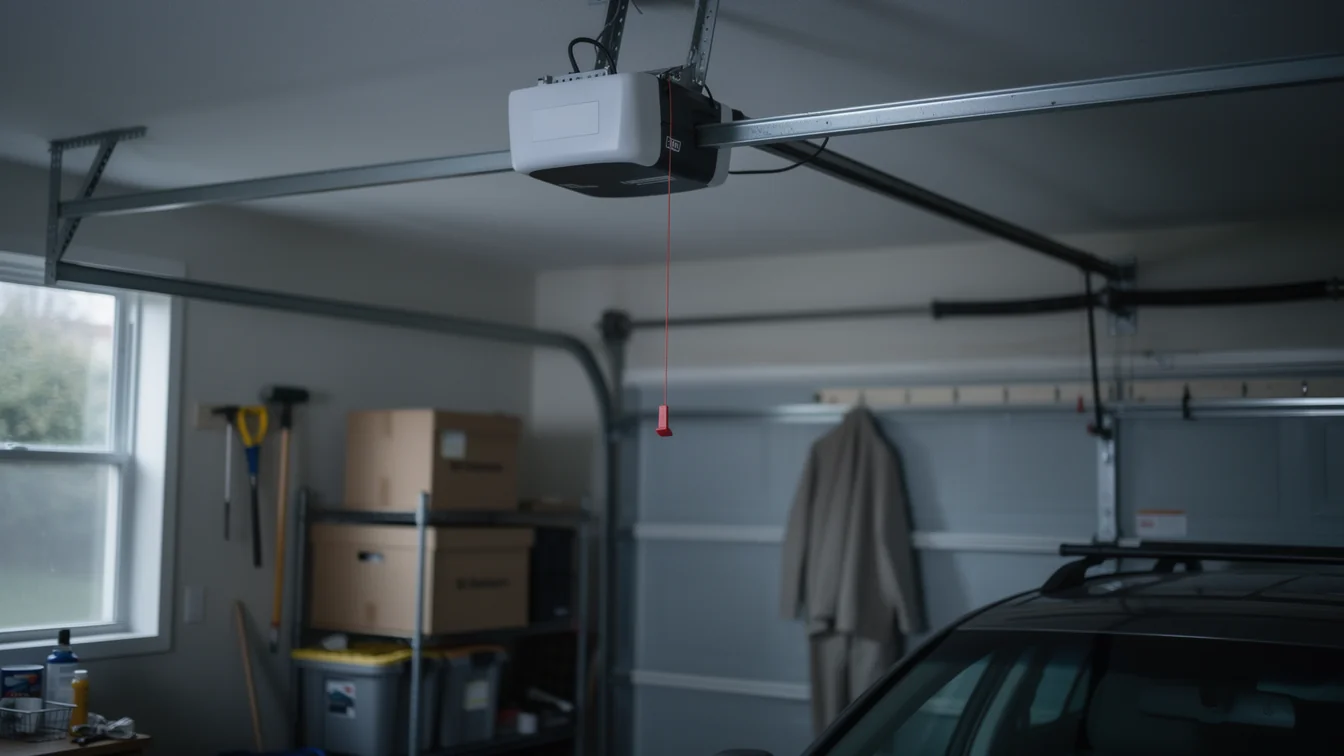
When the power cuts, those older units sit dead until the power comes back, and the homeowner is stuck pulling the manual release cord in the dark to get a car out. Newer openers with battery backup will cycle the door a set number of times on battery power alone, but that battery has a shelf life, and nobody checks it until the day they need it.
The other pattern we see is intermittent response - the remote works sometimes, the wall button sometimes, and it's not the opener at all but a loose wire nicked during an insulation upgrade or a garage remodel somewhere along the way in a house that's been through a few owners.
The area
Leaving It Alone
An opener that still runs the door but makes a new noise, or responds late to the remote, is not an emergency. It's worth watching for a week or two rather than calling the day you notice it, especially if the door itself is moving smoothly and the issue seems electrical.
What you shouldn't ignore is a battery backup that fails its self-test, or an opener that's stopped reversing on obstruction - that's a safety feature, not a convenience one, and it matters more in houses with the original 1960s-70s hardware where the safety eye may have been added later rather than built in.
We'll say the honest thing here: if your opener is original to a house built in that median 1978 window and it's never been replaced, patching one more part onto it is often throwing money at a unit that's already past where parts support makes sense. There's a point where replacement is the cheaper call over a two-year span, not the repair.
What we find
What the Weather Here Does to It
New Berlin sits in a cold-severe climate band, and that matters for openers in two specific ways. First, cold snaps are exactly when the local grid is most likely to lose power - ice on lines, high heating load - which is also exactly when you most need the door to open without fighting it by hand. A battery backup that's five years old and has never been tested is a bad surprise on the one night you need it.
Second, cold affects the opener itself, not just the power supply. Circuit boards and capacitors in unheated garages slow down in deep cold, and a chain-drive unit built decades ago wasn't engineered with modern cold-weather tolerances in mind. That's a bigger deal here than it would be in a milder climate band, because the cold isn't occasional - it's a season, every year, on housing stock that in large part predates battery-backup openers altogether.
How we work
What It Costs
We don't have a flat number to put here, because opener cost depends on whether we're talking a wall-button repair, a new logic board, or a full unit swap with battery backup - and that's a real range, not a dodge. What we can say is that the area's median household income, just over $109,000, puts most New Berlin homeowners in a position to choose the battery-backup upgrade rather than defer it, which is the option we'd point toward given the cold-severe outages this area gets.
The honest limitation: we don't install every opener brand on the market, and a very old chain-drive unit sometimes has to be special-ordered for parts, which adds lead time we can't shrink. If your opener is original to the house, ask us for the replacement number up front rather than the repair number - on a unit that age, the repair number is often the wrong one to chase.
Talk to a local pro
Garage door trouble in New Berlin?
Same-day service with honest, upfront quotes.